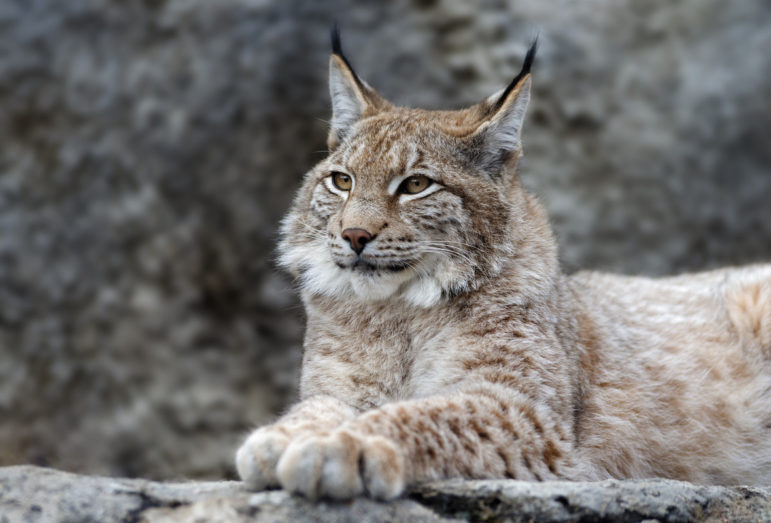
The Canada lynx (Lynx canadensis), also known as the Canadian lynx, is a medium-sized wild cat native to Canada, Alaska, and northern regions of the United States. Recognized by its long ear tufts, thick fur, short tail with a black tip, and snowshoe-like paws, this species is well-adapted to life in cold boreal forests. The lynx plays a key role in the North American ecosystem, particularly as a specialist predator of the snowshoe hare, a relationship that drives its population cycles.
Characteristics of the Canada Lynx
The Canada lynx measures 73–107 cm in length, stands about 48–56 cm tall at the shoulder, and weighs 5–17 kg, with males typically larger than females. Its hindlimbs are longer than its forelimbs, giving it a distinctive sloping posture. The thick fur, which varies from grey to brown depending on the season, provides insulation against extreme cold.
The lynx’s paws are broad and heavily furred, allowing it to move efficiently on deep snow—one of its most notable adaptations compared to its close relative, the bobcat. Other distinguishing features include its short tail with a completely black tip, long ear tufts, and ruffed fur around the cheeks.
Habitat and Distribution
The Canada lynx inhabits dense boreal forests across Canada and Alaska, and extends into parts of the northern United States, including the Rocky Mountains, Great Lakes region, and northern New England. It has been successfully reintroduced in Colorado after local extirpation. While it thrives in old-growth and regenerating forests, it struggles in heavily logged or agricultural landscapes.
Historically, the lynx ranged across much of the northern U.S., but today it is considered extirpated in states such as New York, Pennsylvania, and Massachusetts. The species is most abundant in areas where snowshoe hares are plentiful.
Diet and Hunting
The Canada lynx is a specialist predator whose diet relies heavily on the snowshoe hare (Lepus americanus), which makes up 35–97% of its food intake depending on prey availability. When hare numbers decline, lynxes hunt grouse, red squirrels, voles, ducks, and young deer or caribou.
The lynx typically hunts at night or twilight, using ambush tactics to capture prey on well-worn hare trails. It kills by delivering a bite to the neck or head. Lynxes consume about 0.6–1.2 kg of food daily and may cache kills for later use. Their populations follow the cyclical rise and fall of hare populations every 8–11 years.
Behavior and Reproduction
The Canada lynx is generally solitary, with individuals of the same sex avoiding each other. Mating occurs from March to early April, with females giving birth after a gestation of two to three months. Litters usually contain one to eight kittens, depending on prey availability.
Kittens are weaned at 12 weeks and begin hunting by 7–9 months of age. Most disperse at about 10 months, although female offspring may remain closer to their mother’s range. Lynxes reach maturity at 10 months for females and two to three years for males.
In the wild, lynxes typically live up to 10 years, though some reach 16 years, while captive individuals may survive up to 27 years.
Conservation and Human Interaction
The Canada lynx is classified as Least Concern by the IUCN Red List due to its wide distribution and stable populations in northern regions. However, it faces localized threats in the southern part of its range, including habitat loss, competition with coyotes, and hybridization with bobcats.
The species is protected in the United States under the Endangered Species Act in several regions, while fur trapping remains legal in Canada and Alaska, regulated through quotas. Pelts are valuable in the fur trade, though international regulations under CITES Appendix II help prevent overexploitation.
Reintroduction programs, particularly in Colorado, have been successful in re-establishing breeding populations. Ongoing conservation efforts focus on habitat protection, population monitoring, and reducing risks from road mortality and human encroachment.