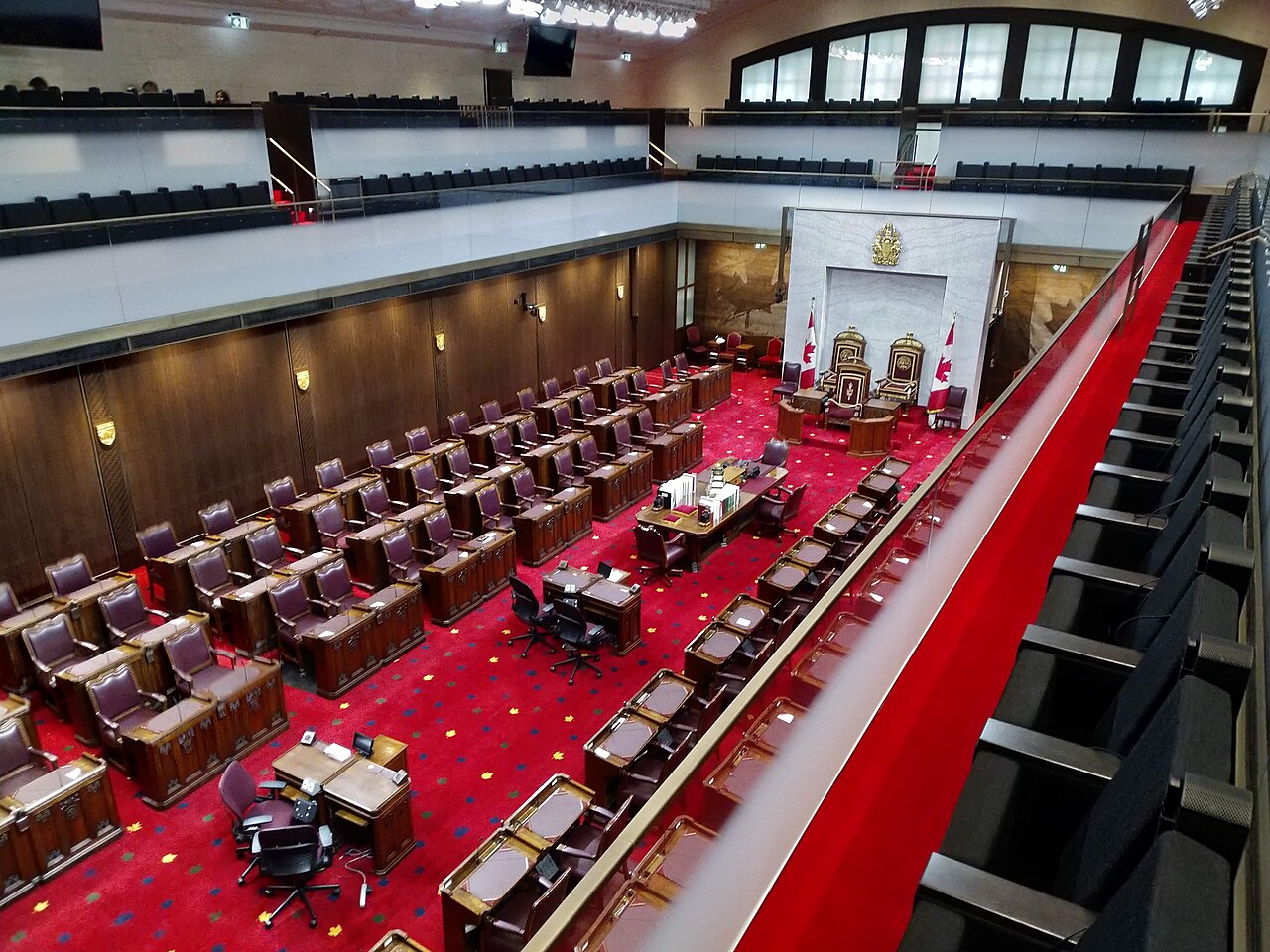
The Senate of Canada (Sénat du Canada) serves as the upper house of the Parliament of Canada, working alongside the House of Commons and the Crown to form the nation’s bicameral legislature. Established in 1867 under the Constitution Act, the Senate was modeled on the British House of Lords and conceived as a chamber of “sober second thought”, a place where legislation could be carefully reviewed, amended, or delayed to protect regional and minority interests.
Although senators are unelected and appointed by the governor general on the advice of the prime minister, the Senate remains an essential institution in balancing Canada’s federal system.
Structure and Composition
The Senate consists of 105 seats, allocated regionally rather than strictly by population:
- Ontario division – 24 senators
- Quebec division – 24 senators
- Maritime division (Nova Scotia, New Brunswick, Prince Edward Island) – 24 senators
- Western division (British Columbia, Alberta, Saskatchewan, Manitoba) – 24 senators
- Newfoundland and Labrador – 6 senators
- Territories (Yukon, Northwest Territories, Nunavut) – 1 senator each
Quebec is unique in that its senators are assigned to 24 specific districts, ensuring linguistic and cultural representation.
Senators must be Canadian citizens, aged 30–75, residents of the province they represent, and owners of at least $4,000 worth of property. Since 1965, all senators face mandatory retirement at age 75, replacing the original system of lifetime appointments.
As of 2025, the Senate has a female majority, with women holding over 54% of seats, a higher rate of representation than in the House of Commons.
Role and Powers
In theory, the Senate holds nearly equal legislative power to the House of Commons:
- Approves or rejects bills – No bill can become law without Senate approval.
- Amends legislation – Often makes technical or detailed improvements.
- Investigates issues – Through committees, the Senate studies policies ranging from foreign affairs to Indigenous rights and healthcare.
However, by convention, the Senate rarely blocks legislation outright. Its defeats of House-approved bills—such as the Naval Aid Bill (1913), the 1988 Free Trade Agreement legislation, and the 1991 abortion bill—remain exceptions rather than the norm.
The Senate cannot initiate money bills (those imposing taxes or authorizing spending), a power reserved for the Commons.
History
The Senate was created at Confederation in 1867, with 72 seats representing Ontario, Quebec, Nova Scotia, and New Brunswick. Its purpose was twofold:
- Regional representation – To balance power between populous provinces and smaller regions.
- A check on democracy – To temper the “democratic excesses” of the elected Commons, as articulated by Sir John A. Macdonald.
Over time, membership expanded to include Manitoba (1870), British Columbia (1871), Prince Edward Island (1873), Alberta and Saskatchewan (1905), Newfoundland (1949), and later the territories.
Significant moments include:
- 1929 Persons Case – Women were declared eligible for appointment, leading to Cairine Wilson’s appointment as Canada’s first female senator.
- 1965 reform – Introduced the retirement age of 75.
- 1990 GST Bill – Prime Minister Brian Mulroney invoked a constitutional provision to appoint 8 extra senators temporarily, ensuring passage of the Goods and Services Tax.
- 2014 Supreme Court ruling – Declared that Senate elections or term limits would require a full constitutional amendment, halting reform attempts.
- 2016 onward – Prime Minister Justin Trudeau introduced a non-partisan appointment process through the Independent Advisory Board, reshaping the chamber into one dominated by independent senators.
Senate Reform
Debate over reform has persisted for more than a century. Proposals have ranged from abolition to the so-called Triple-E Senate (elected, equal, effective), which gained traction in Western Canada during the 1980s.
While full reform has proven constitutionally difficult, recent changes have made the Senate less partisan. Most senators today sit as part of independent groups—the Independent Senators Group (ISG), the Canadian Senators Group (CSG), and the Progressive Senate Group (PSG)—rather than aligning strictly with federal political parties.
Committees and Investigations
The Senate is especially influential through its committee system, which examines legislation in depth and conducts inquiries. Notable committees include:
- Legal and Constitutional Affairs
- National Security and Defence
- Energy, the Environment and Natural Resources
- Human Rights
Investigative work has often shaped national conversations. For example, the Davey Commission in the 1960s highlighted media concentration, and the Kirby Report in the 2000s addressed Canada’s healthcare and mental health challenges.
Modern Operations
The Senate sits in the Senate of Canada Building (the former Ottawa Union Station) while Parliament Hill’s Centre Block undergoes renovations. Proceedings have been broadcast live since 2019, making the chamber more accessible to Canadians.
Senators earn an annual base salary of CA$184,800 (2025), with additional compensation for leadership roles such as the Speaker, Opposition Leader, and committee chairs.
Conclusion
Though sometimes criticized for its unelected nature, the Senate of Canada continues to play a vital constitutional role. It remains a chamber of regional representation, legislative review, and investigative insight—a place where Canada’s laws receive a deeper level of scrutiny.
In the 21st century, its transformation toward independence has strengthened its reputation as a non-partisan body, making it one of the most unique upper houses among parliamentary democracies.