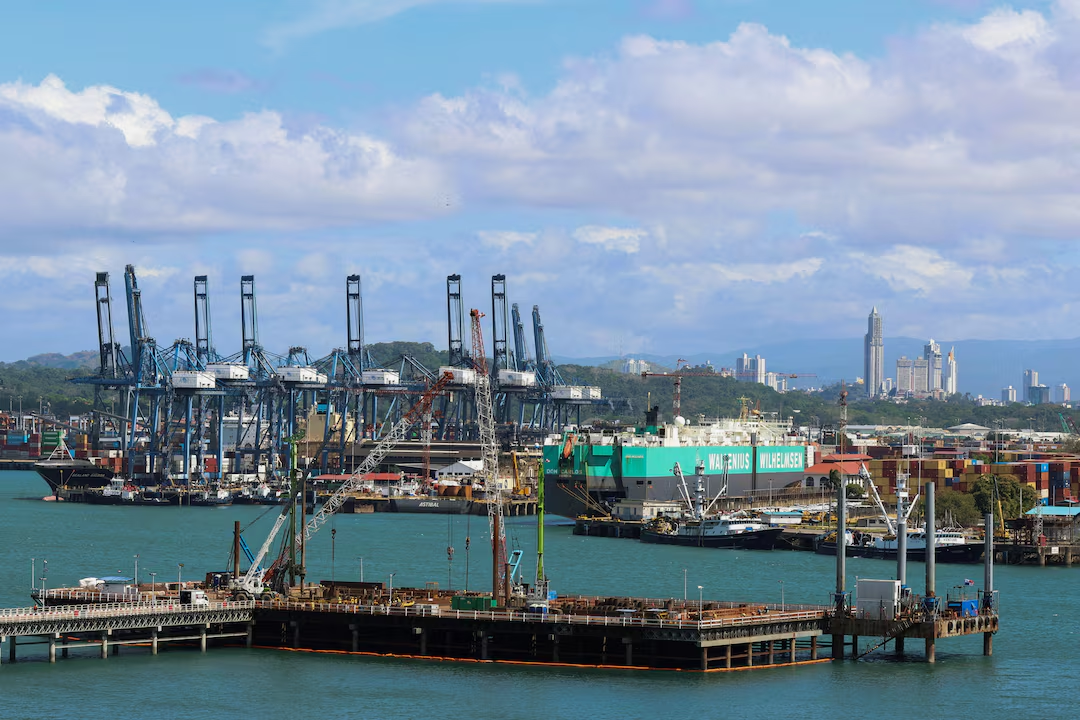
Panama’s Supreme Court has annulled the key port contracts held by a CK Hutchison subsidiary, creating major uncertainty for operations at the Panama Canal. The ruling directly disrupts a proposed twenty-three billion dollar global port sale by the Hong Kong-based conglomerate. Consequently, the future of container terminals at the canal’s Atlantic and Pacific entrances is now in doubt. The court found the laws underpinning the contracts unconstitutional. This decision represents a significant victory for US efforts to curb Chinese influence over vital global trade routes.
The Panama Ports Company, the Hutchison subsidiary, has operated the terminals since the 1990s. It condemned the ruling, stating it lacks legal basis and jeopardizes stability. The company reserved the right to begin international legal proceedings. The annulled port contracts were central to CK Hutchison’s plan to sell dozens of ports worldwide to a consortium led by BlackRock and Mediterranean Shipping Company. The court’s intervention now clouds that massive transaction and escalates geopolitical tensions in a strategic maritime corridor.
Geopolitical Victory for US, Blow to Chinese Interests
The court’s decision is a clear win for the United States in its rivalry with China over trade infrastructure. US President Donald Trump has actively pushed to reduce Chinese control near the Panama Canal, which handles five percent of global maritime trade. US Secretary of State Marco Rubio said Washington was encouraged by the ruling. John Moolenaar, chair of the US House Select Committee on China, thanked Trump and Panamanian President Jose Raul Mulino, framing it as a victory for shared values and security.
China reacted with strong disapproval. The Foreign Ministry stated it would take all necessary measures to defend Chinese enterprises’ rights. Hong Kong’s government also strongly opposed the ruling, calling it an unreasonable means harming legitimate business interests. China had previously opposed the BlackRock-MSC deal because it would place the ports under majority US ownership. Instead, Beijing pushed for state-owned COSCO to take a controlling stake. The annulment of the port contracts therefore blocks a Chinese-backed alternative as well, creating a complex stalemate.
Immediate Operational and Legal Fallout
Panamanian President Mulino moved quickly to assure continuity. He instructed the Maritime Authority to meet with PPC to coordinate necessary actions, promising no operational disruption or layoffs. APM Terminals Panama, a Maersk subsidiary, offered to operate the Balboa and Cristobal terminals temporarily to prevent trade impacts. However, the legal void created by the annulled port contracts requires a new framework. Panama will likely need to draft new laws and potentially launch fresh tender processes for the terminals.
CK Hutchison faces substantial financial and strategic repercussions. Its shares fell four point six percent in Hong Kong following the news. The company invested one point eight billion dollars in the Panamanian ports over three decades. Analysts expect near-term weakness and a delayed or restructured global sale. The company will almost certainly initiate international arbitration against Panama, claiming breach of contract and seeking significant compensation. This legal battle could last for years, creating long-term uncertainty.
Impact on the Global Port Sale and Market Reactions
The twenty-three billion dollar sale to BlackRock and MSC is now in jeopardy. The Panamanian terminals were a cornerstone asset in that global portfolio. The buying consortium did not immediately comment, but the deal’s valuation and structure must be renegotiated. The court ruling introduces a major regulatory risk that potential buyers did not originally price in. Consequently, the entire transaction may be delayed, altered, or potentially collapse.
Market analysts note the need for a new sale structure. David Blennerhassett of Ballingal Investment Advisors stated the new structure could be substantially delayed. CK Hutchison must now weigh its options, including potentially excluding the Panamanian assets from the sale or selling them under a different legal arrangement. This uncertainty affects not only Hutchison but also the global shipping and logistics sector, which values stability in key chokepoints like the Panama Canal.
Broader Implications for Global Trade and Investment
The annulment of decades-old port contracts sends a chilling signal to international investors. It highlights the political risks associated with critical infrastructure investments, especially when great power competition is involved. Panama’s legal certainty is now under scrutiny. The ruling may encourage other nations to revisit contracts with foreign firms under geopolitical pretexts. This could lead to a wave of disputes and a more fragmented global investment landscape.
For global trade, uninterrupted port operations are essential. The Panama Canal is a crucial transshipment hub where containers move between vessels on different routes. Any prolonged dispute or operational hiccup could ripple through supply chains. While temporary operators may step in, the lack of a long-term, stable contract holder discourages further private investment in maintenance and expansion. This could gradually degrade the canal’s efficiency and competitiveness relative to other routes.
Path Forward for Panama and the Terminals
Panama’s government faces a difficult path. It must ensure continuous port operations while designing a new legal and regulatory framework. President Mulino mentioned public-private partnerships as a possible model if the contracts were invalidated. This suggests the state may seek a new tender process with revised terms that are more favorable to Panama. However, any new process will be intensely scrutinized by both US and Chinese interests, turning a commercial decision into a geopolitical litmus test.
The ultimate resolution will test Panama’s sovereignty and its ability to navigate between major powers. The country benefits immensely from canal-related revenue and must balance economic interests with political pressures. The court’s decision, while legally focused, has undeniable political origins. Panama’s next steps will determine whether it can reclaim control over its assets or become further entangled in US-China rivalry. The stability of a global trade artery hangs in the balance.