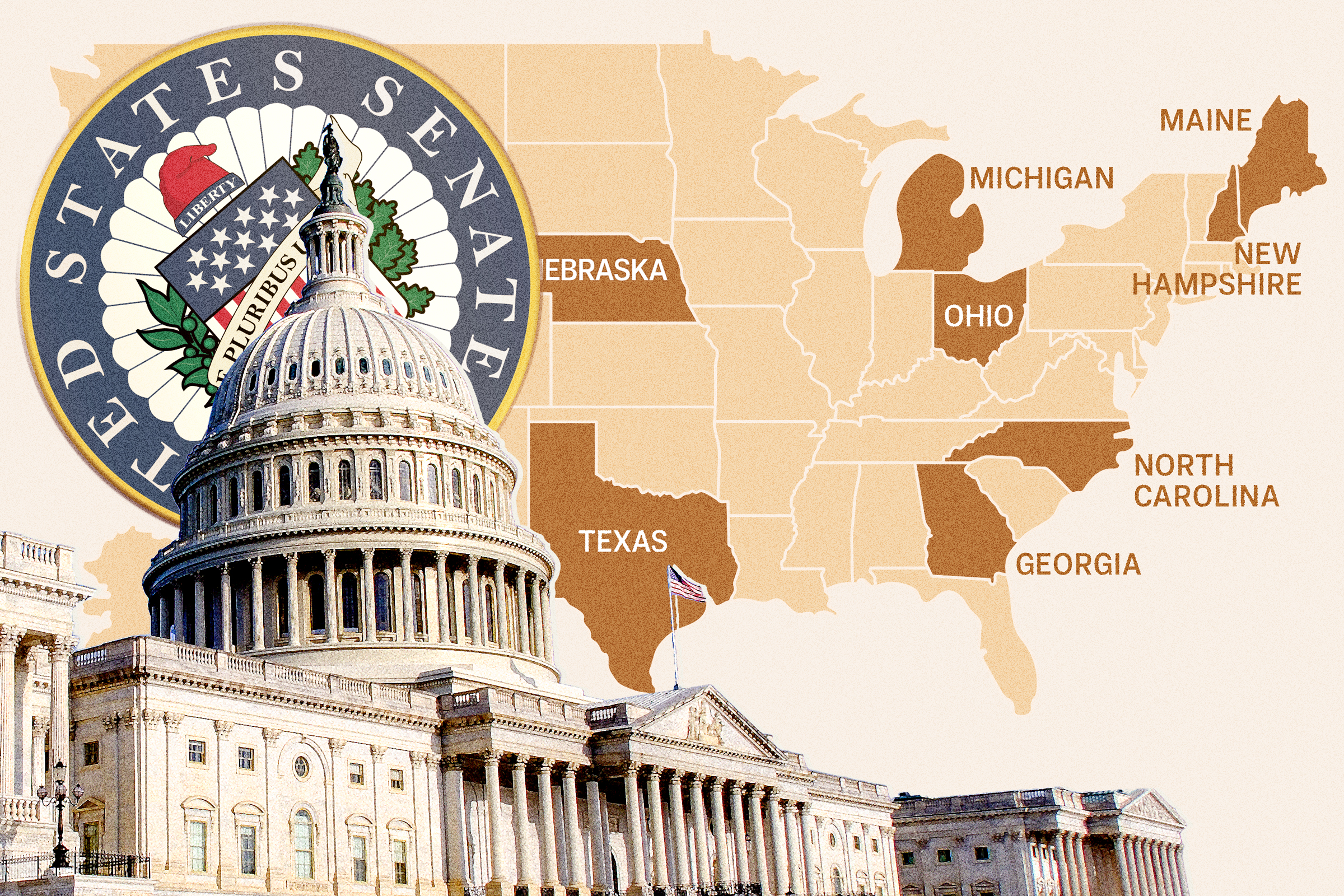
As 2025 comes to a close, political pundits and voters alike are already setting their sights on the 2026 midterm elections. The Senate is poised to be a key battleground, with 33 seats up for election—20 currently held by Republicans and 13 by Democrats. Republicans currently maintain a 53–47 majority in the Senate, but they face several challenges in key races that could determine the balance of power in Washington. With polling, retirements, and primaries shaping the electoral landscape, both parties are eyeing pivotal races to hold or flip seats. Here’s a detailed look at the top 8 Senate races to watch as we approach the 2026 general election.
1. Texas: The Lone Star State’s Heated Contest
Texas is always a political battleground, and the 2026 Senate race is no exception. Republicans are facing a high-profile primary challenge to hold the seat of incumbent Sen. John Cornyn. Texas Attorney General Ken Paxton has announced his bid to replace Cornyn, bringing his controversial political career to the forefront. Paxton, despite being acquitted after a 2023 impeachment trial, has remained a divisive figure in Texas politics, with his America First brand of populism running counter to establishment Republican interests.
On the GOP side, Rep. Wesley Hunt (R-Texas) has also thrown his hat into the ring, setting up a three-way primary. Meanwhile, Democrats are hopeful for a breakthrough, with Texas state Rep. James Talarico leading the charge. Talarico, known for his fierce stance on redistricting, could challenge Republican dominance in the state, though Paxton remains a slight favorite in current polls. The race will be tightly contested with a primary scheduled for March 3, 2026.
2. Georgia: Can Republicans Reclaim a Senate Seat?
Georgia’s Senate races have become closely watched in recent years, particularly after Sen. Raphael Warnock (D-Ga.) won a tight runoff election in January 2021. Now, the stakes are high again as Republicans seek to unseat Warnock and flip one of Georgia’s Senate seats. A crowded Republican primary includes Rep. Mike Collins (R-Ga.), Rep. Buddy Carter (R-Ga.), and former football coach Derek Dooley, with each hoping to earn the endorsement of former President Donald Trump.
Although Georgia has leaned Republican in recent cycles, Warnock remains a strong incumbent, and polling suggests he has a narrow lead in hypothetical matchups against the GOP contenders. The race will be an intense one, with the primary taking place on May 19, 2026, and the runoff set for June 16, 2026.
3. Maine: Susan Collins Faces Her Toughest Challenge Yet
Sen. Susan Collins (R-Maine) has long been a stalwart of New England politics, but her seat is now a top target for Democrats. After fending off a strong challenge from Sara Gideon in 2020, Collins now faces a strong field of Democratic contenders. Military veteran Graham Platner and Maine Gov. Janet Mills are vying for the Democratic nomination, with Platner earning an endorsement from Sen. Bernie Sanders.
Collins is facing heightened scrutiny due to her controversial votes in recent years, and polling shows her vulnerable in a potential matchup with Mills. Despite this, Collins remains a formidable figure in Maine politics, and the race will be one of the most closely watched in the nation. Maine’s primary is scheduled for June 9, 2026.
4. Michigan: A Key Battleground After Gary Peters’ Retirement
Michigan, a state that has become synonymous with battleground politics, is set to feature a highly competitive Senate race in 2026. With Sen. Gary Peters (D-Mich.) retiring, Republicans are hoping to capitalize on the vacancy and make gains in this crucial state. Former Rep. Mike Rogers (R-Mich.), who lost a narrow 2024 race to Sen. Elissa Slotkin (D-Mich.), is the GOP’s presumptive nominee.
On the Democratic side, Rep. Haley Stevens (D-Mich.) leads the field, but she faces stiff competition from Michigan state Sen. Mallory McMorrow and physician Abdul El-Sayed. Although the race favors Democrats in a state that has leaned left in recent years, Rogers’ strong name recognition and Trump’s endorsement could make it a tight contest. Michigan’s primary is set for August 4, 2026.
5. Ohio: Can Sherrod Brown Make a Political Comeback?
Once a swing state, Ohio has become increasingly Republican in recent years. However, Sen. Sherrod Brown (D-Ohio) is hoping to change that. After losing his seat in 2024 to Sen. Bernie Moreno (R-Ohio), Brown is making a comeback bid in the 2026 election. Brown, who served in the Senate from 2007 to 2025, will compete in a special election to fill the remaining two years of Vice President JD Vance’s term.
Republicans are rallying behind Sen. Jon Husted (R-Ohio), who was appointed by Gov. Mike DeWine to fill the vacancy left by Vance. While Husted leads in early polling, Brown’s campaign will focus on appealing to moderate and working-class voters who have historically supported Democrats in the state. Ohio’s primary is scheduled for May 5, 2026.
6. North Carolina: Roy Cooper Takes on Michael Whatley
North Carolina is another key swing state that will see a competitive Senate race in 2026. With Sen. Thom Tillis (R-N.C.) retiring, both parties are scrambling to secure the seat. Former Gov. Roy Cooper (D-N.C.), a popular Democrat with a proven track record of winning statewide office, has announced his candidacy for the Senate.
On the Republican side, Republican National Committee Chairman Michael Whatley is running, with Trump’s endorsement helping to boost his profile. Early polling shows Cooper with a narrow lead, but Republicans are hoping to hold the seat with Whatley’s appeal to conservative voters. The primary is scheduled for March 3, 2026, with any runoff set for May 12, 2026.
7. Nebraska: Pete Ricketts Faces an Independent Challenge
In Republican stronghold Nebraska, the GOP is heavily favored to retain the Senate seat held by Sen. Ben Sasse (R-Neb.), who retired in 2024. Pete Ricketts, the former governor of Nebraska, was appointed to fill the vacancy and is the odds-on favorite to hold the seat. However, independent candidate Dan Osborn, who nearly won the seat in 2024, poses a challenge to Ricketts’ re-election bid.
While Ricketts is favored in early polling, Osborn’s independent candidacy could appeal to voters disillusioned with the two major parties. Nebraska’s primary is set for May 12, 2026.
8. New Hampshire: Jeanne Shaheen’s Retirement Opens the Door
New Hampshire has long been a blue state, but Republicans are hoping to make gains in the Senate with the retirement of Sen. Jeanne Shaheen (D-N.H.). Former Sens. John E. Sununu (R-N.H.) and Scott Brown (R-Mass.) are both vying for the GOP nomination, with Sununu leading the primary race by double digits.
On the Democratic side, Rep. Chris Pappas (D-N.H.) is the frontrunner and remains competitive in a general election matchup against either of the former senators. The race could be a close one, with New Hampshire’s independent voters playing a key role. The primary is scheduled for September 8, 2026.